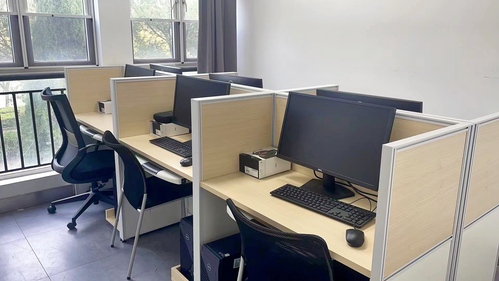
Research in psycholinguistics and neurolinguistics typically begins with behavioral experiments. Researchers recruit participants to perform pre-designed tasks, measuring data such as millisecond-level reaction times, accuracy, and ratings, which reflect psychological and cognitive processes. Once reliable and stable results are obtained, experiments may then proceed to incorporate other methods, such as brain imaging techniques. The Institute of Language Sciences has two behavioral laboratories, each equipped with high-performance desktop computers (12 units), high-refresh-rate monitors (12 units), and noise-canceling headphones (12 sets, used for auditory stimuli). These experimental devices are compatible with commonly used experimental software (e.g., Psychtoolbox, PsychoPy, E-prime, Experiment Builder), meeting the needs of most psycholinguistic experiments.
Hongkou Campus: Room 607, Building 5, 550 Dalian West Road, Shanghai, China
Tel: +86-21-3537 2364 / +86-21-3537 2393
Songjiang Campus: Room 101, Building 5, 1550 Wenxiang Road, Shanghai, China
Tel: +86-21-6770 1865
Copyright @ Institute of Language Sciences. All rights reserved.