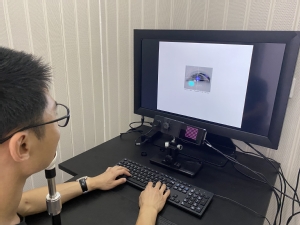
Eye-tracking technology is widely used in the field of psycholinguistics and neurolinguistics, especially in reading research. The Eye-tracking Laboratory at the Institute of Language Sciences is equipped with an Eyelink 1000 Plus desktop eye tracker, which records the fixation points of subjects during experimental tasks with millisecond-level time resolution (commonly used sampling rate of 1000 Hz). In psycholinguistic research, the Eyelink 1000 Plus helps researchers explore the instantaneous responses involved in language processing. For example, by recording fixation durations and eye movement paths during reading, it can reveal cognitive load and information processing sequences in language comprehension. Furthermore, the device supports customizable experimental designs, allowing researchers to analyze the effects of syntactic, lexical, semantic, and pragmatic processing on eye movement patterns.
Hongkou Campus: Room 607, Building 5, 550 Dalian West Road, Shanghai, China
Tel: +86-21-3537 2364 / +86-21-3537 2393
Songjiang Campus: Room 101, Building 5, 1550 Wenxiang Road, Shanghai, China
Tel: +86-21-6770 1865
Copyright @ Institute of Language Sciences. All rights reserved.