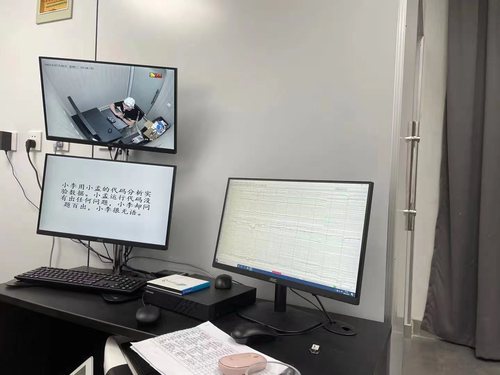
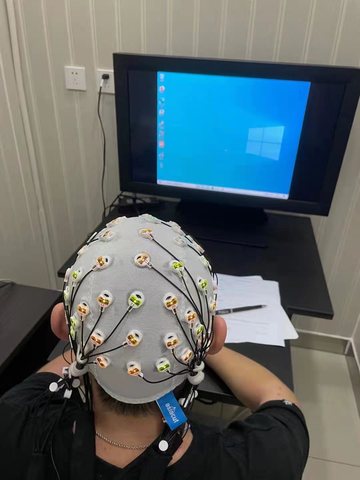
Electroencephalography (EEG) technology is widely used in psycholinguistic and neurolinguistic research to record real-time changes in brain activity. By analyzing participants' brain responses during specific experimental tasks, EEG can reveal the neural basis of related psychological and cognitive processes. The EEG laboratory at the Institute of Language Sciences is equipped with two Brain Products EEG systems and a 64-channel active/passive electrode EEG cap, capable of accurately measuring millisecond-level brain activity (with a typical sampling rate of 500 Hz). Additionally, the laboratory is equipped with Biopac multi-channel physiological monitoring equipment to record other physiological signals from participants, such as electrocardiogram (ECG), electromyogram (EMG), and pulse rate.
In psycholinguistic research, EEG technology provides a valuable tool for exploring language processing mechanisms. For example, by analyzing event-related potentials (ERPs) and neural oscillations associated with linguistic stimuli, researchers can gain deeper insights into the neural responses involved in language processing. Both EEG and physiological signal recordings have high temporal resolution, and can be synchronized through external data interface modules, enabling simultaneous examination of brain responses and other physiological indicators (such as heart rate and muscle tension) in relation to experimental tasks. This integrated approach provides strong support for a comprehensive understanding of the cognitive processes underlying language comprehension and production.
Hongkou Campus: Room 607, Building 5, 550 Dalian West Road, Shanghai, China
Tel: +86-21-3537 2364 / +86-21-3537 2393
Songjiang Campus: Room 101, Building 5, 1550 Wenxiang Road, Shanghai, China
Tel: +86-21-6770 1865
Copyright @ Institute of Language Sciences. All rights reserved.