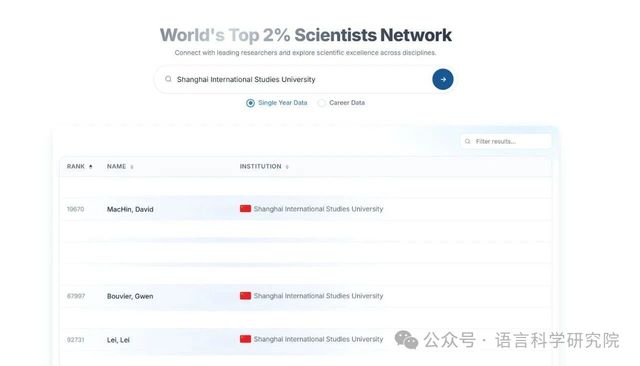
Recently, Stanford University and the internationally authoritative academic publisher Elsevier jointly released the 2026 World's Top 2% Scientists list. A total of 9 scholars from Shanghai International Studies University were selected, among whom three scholars from the Institute of Linguistic Sciences—Professor David Machin, Professor Gwen Bouvier, and Professor Lei Lei—made the list. Their specific rankings are as follows:
David Machin
World rank: 19,670; rank in Linguistics: 128.
Gwen Bouvier
World rank: 67,997; rank in Linguistics: 368.
Lei Lei
World rank: 92,731; rank in Linguistics: 464.
The World's Top 2% Scientists list is jointly released by Stanford University and Elsevier, based on scientometric analysis using Scopus, the world's largest abstract and citation database. The list is calculated and ranked strictly according to the composite citation score among approximately ten million researchers worldwide, covering 20 disciplinary fields and 174 subfields, and ultimately selects scholars ranked in the global top 100,000 or the top 2% of each subfield. Because of its comprehensive evaluation dimensions, objective data, and strong interdisciplinary comparability, it has become one of the scientist evaluation systems recognized by the international academic community as having high authority and broad influence.
In the list announced this time, three scholars from our Institute were selected for the 2026 World's Top 2% Scientists list. This is not only a high recognition of their individual academic achievements, but also a reflection of our Institute's commitment to high-quality research development and its active promotion of interdisciplinary integration between linguistics and cutting-edge sciences such as data science and artificial intelligence. In the future, the Institute of Linguistic Sciences will continue to focus on linguistic science research, advance the in-depth development of theoretical linguistics and applied linguistics research, conduct research on frontier issues in language data science and neuro/psycholinguistics, and cultivate more high-end talent in linguistic sciences.
Scholar Profiles
David Machin
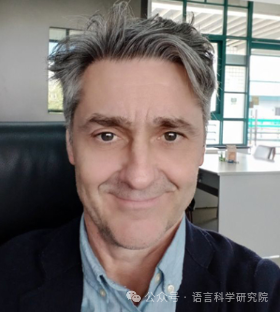
David Machin is a Distinguished Professor and Doctoral Supervisor at Shanghai International Studies University and an internationally renowned expert in critical discourse analysis and multimodal analysis. He not only continues to produce high-level research outputs, but also devotes himself to leading young faculty members and students at our Institute in research collaboration. Professor Machin has published more than 10 monographs and edited volumes and over 100 journal articles and book reviews in SSCI and A&HCI journals. His representative works have long ranked among the most highly cited and most read. He serves as co-editor of a book series at Bloomsbury Publishing and is highly praised by students at our Institute for his highly engaging, student-centered teaching style.
Gwen Bouvier

Gwen Bouvier is a Distinguished Professor and Doctoral Supervisor at Shanghai International Studies University. Her main research areas include digital communication, social media, and online ethnography. She serves as an editor of the SSCI journal Social Semiotics and as an editorial board member of multiple international journals. She is not only very active in international academic exchange and has been invited to give keynote speeches multiple times, but also actively organizes panels at international conferences such as CADAAD. Her latest book, Qualitative Research Using Social Media (2nd edition), is forthcoming, and she continues to lead cutting-edge discussions in this field.
Lei Lei
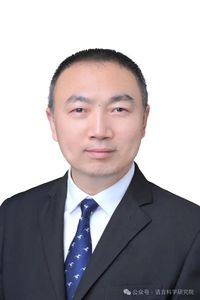
Lei Lei is a Professor and Doctoral Supervisor at Shanghai International Studies University. His research interests include corpus linguistics, digital humanities in language, and quantitative linguistic research. He has published 5 monographs with Cambridge University Press and other publishers, more than 60 papers in SSCI journals such as Applied Linguistics, and has led 2 National Social Science Fund projects. Professor Lei Lei's team has independently developed the Alpha series of text analysis tools for Modern Chinese and Ancient Chinese, providing important tools for linguistic and digital humanities research.