Conference Announcement
To advance interdisciplinary research in linguistics, promote the development of language science, and foster innovation and application of multilingual intelligent technologies, the Forum on Language Science and Multilingual Intelligent Applications will be held from June 13 to 14, 2026. The forum is organized by the Institute of Language Sciences, Shanghai International Studies University (SISU), hosted by the Key Laboratory of Language Sciences and Multilingual Intelligent Applications, SISU, and co-organized by the SISU Linguistics Team (a peak discipline team), the Editorial Office of Corpus-based Studies across Humanities, and the Interdisciplinary Linguistics Research Committee of the China Alliance of Foreign Language Disciplines Development. The conference will feature keynote speeches and parallel sessions. Scholars, researchers, and students are warmly invited to submit papers and attend.
01 Conference Theme
Language Science and Large Language Model Research
02 Conference Date
June 13–14, 2026
03 Conference Venue
Songjiang Campus, Shanghai International Studies University
04 Conference Program
Afternoon of June 12, 2026: Workshop on Language Science and Large Language Model Application Research
Morning of June 13, 2026: Keynote Speeches I
Afternoon of June 13, 2026: Parallel Sessions
Morning of June 14, 2026: Keynote Speeches II
05 Keynote Speakers
Domestic Invited Experts (in order of the number of strokes in their surnames)
Ding Nai (Zhejiang University)
Deng Yaochen (Dalian University of Foreign Languages)
Wang Chunhui (Capital Normal University)
Liu Dilin (University of Alabama)
Sun Kun (Tongji University)
Xun Endong (Beijing Language and Culture University)
Yuan Wei (National University of Defense Technology)
Yuan Jiahong (University of Science and Technology of China)
Huang Wei (Beijing Language and Culture University)
Huang Lihe (Tongji University)
International Invited Experts
CHO Taerin (Yonsei University)
KANG Hyounhwa (Yonsei University)
KIM Hansaem (Yonsei University)
06 Participation Method
The conference is free of charge. Participants are responsible for their own accommodation, meals (except lunch provided during the conference), and transportation. Please arrange your own accommodation and travel.
07 Workshop
Workshop Content
Session 1: Statistical Modeling for Language, Cognition, and AI (Instructor: Prof. Wu Shiyu, Shanghai Jiao Tong University)
This session addresses the data analysis needs in linguistics, second language acquisition, psycholinguistics, and AI language research. It systematically introduces how to choose appropriate statistical models based on different research questions and data structures. Using concrete research cases, it demonstrates modeling pathways from linear models to generalized linear models, mixed-effects models, and Bayesian models. Examples include: using linear models to analyze L1/L2 reading performance, using generalized linear models for binary judgment tasks such as framing effects and truth illusion, using linear and generalized linear mixed-effects models for repeated measures across subjects and items, and further introducing Bayesian models for uncertainty estimation and human-AI comparison studies.
The session emphasizes not only how to run models but also the research logic behind statistical modeling: what types of dependent variable structures correspond to different types of linguistic data, why one cannot use the same model for all problems, how to interpret main effects and interactions, and how to visualize complex model results. Additionally, by drawing on comparative studies of human cognition and AI behavior, the session will discuss whether classic cognitive effects such as affective learning, framing effects, and truth illusion also appear in large language models, and how statistical models can help rigorously test such questions.
Participants will understand that statistical modeling is not merely a set of technical tools but a way of generating evidence that connects language, cognition, and AI research. The session aims to help researchers move from knowing how to use statistical methods to being able to select models, interpret them, and use them to answer theoretically valuable questions based on the research problem.
Session 2: From Replication to Auditing: Verification Pathways and Practical Approaches in Empirical Linguistics Research in the Era of Large Language Models (Instructor: Prof. Wang Li, Shanghai Normal University)
Generative AI is reshaping the workflow of empirical research in linguistics. Large language models can assist with literature review, code writing, data analysis, and result interpretation. However, the critical question is not what can LLMs do? but rather how researchers can verify, replicate, and audit the results they produce. This session does not offer a general introduction to AI tools but focuses on trustworthiness assessment, replication pathways, and methodological boundaries in LLM-assisted research. Part 1 will use a published empirical paper from a leading applied linguistics journal (with data and code publicly available) as an example to demonstrate live how to use an LLM to reconstruct its core analytical workflow, using the paper’s published conclusions as a benchmark to verify the code, statistical pathways, and result interpretations generated by the model. Participants will see where LLMs are genuinely effective and where they may generate superficially plausible but incorrect analyses, thereby fostering a research mindset of use AI, but audit AI. Part 2 turns to semantic modeling and visualization, showing how to use word embeddings, semantic spaces, and knowledge graphs to present lexical relations, diachronic change, or cross-language semantic differences between English and Chinese. The session emphasizes that linguistic researchers must still evaluate whether constructs are valid, variables are properly operationalized, measures have theoretical validity, and statistical pathways truly serve the research question. Through the two modules of replication/auditing and semantic modeling, the session aims to help participants establish a more verifiable, transparent, and efficient human-AI collaborative research workflow.
Training Time: June 12, 14:00–16:30
Registration Period: From now until June 12
Training Venue: Lecture Hall 136, Teaching Building No. 5, Songjiang Campus, SISU
Instructors: Prof. Wu Shiyu, Prof. Wang Li
Fee: RMB 500/person; half price for students (RMB 250/person)
Registration and Payment
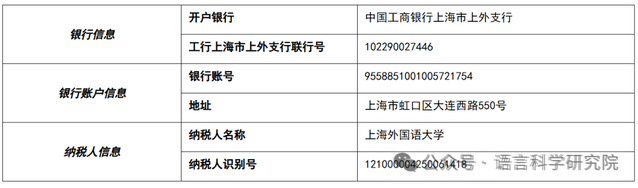
Remittance Payment: Payment should be made via bank transfer. Please include in the transfer remarks: your full name + workshop name. Remittance account details are provided below.
Important Notes
Before the workshop begins, participants who are unable to attend due to legitimate reasons may withdraw and request a refund. Once the workshop has officially started, participants who are unable to continue will be considered to have voluntarily withdrawn, and no refunds will be issued.
As SISU faculty and students cannot receive an invoice from their own university, please contact the organizing committee to confirm the specific registration and payment method if reimbursement is required.
After successful registration and payment:
(1) Please scan the QR code below to fill in your registration and payment information.
(2) You may add WeChat (laogongsisu) with your real name as a note for further communication.

Reminders
During the workshop, SISU will provide invoicing services and training services.
A certificate of completion will be issued by the organizer with an official stamp.
08 Contact Information
Email:ils2002@shisu.edu.cn
Institute of Language Sciences, Shanghai International Studies University
Key Laboratory of Language Sciences and Multilingual Intelligent Applications, SISU
Interdisciplinary Linguistics Research Committee of the China Alliance of Foreign Language Disciplines Development
SISU Linguistics Team (Peak Discipline Team)
Editorial Office of Corpus-based Studies across Humanities