The “Language Data Science” Micro-Program is hosted by the Language Data Science and Applications program at the Institute of Language Sciences, Shanghai International Studies University. The Language Data Science and Applications discipline was established in 2020 as a new field at the Institute. On one hand, it aligns with the Ministry of Education’s New Liberal Arts development strategy, following the trend of interdisciplinary integration in contemporary academic research. On the other hand, it actively responds to the national strategy for the development of artificial intelligence, aiming to cultivate high-end talent in language intelligence.
Language Data Science and Applications is an emerging interdisciplinary field based on information science, statistics, linguistics, and translation studies. It aims to study the various types, states, properties, and patterns of change in language data, in order to reveal the underlying patterns of human language and language behavior, and to explore the application of language data in smart education and artificial intelligence. Rooted in the application of corpora and databases, this discipline conducts language research, translation studies, smart education, and research in AI-related fields driven by language data. It achieves an organic integration of data science with linguistics, translation studies, smart education, and language intelligence, maximizing the understanding and explanation of the nature of language and translation, and advancing the application of language data in areas such as smart education and language intelligence.
The “Language Data Science” course series offered by the Institute of Language Sciences at SISU covers linguistic theory, corpus construction, computational linguistics, programming, and data development. The curriculum is comprehensive and holds significant disciplinary advantages compared to similar courses offered by other universities nationwide. The Institute currently has a faculty of 35 full-time teaching and research staff, including 17 professors/researchers (with 4 international experts), 9 associate professors/associate researchers (with 3 international experts), and 9 lecturers/assistant researchers. In addition, the Institute employs numerous renowned domestic and international scholars as adjunct/visiting researchers. The Institute boasts 2 Changjiang Scholars, 1 “Ten Thousand Talents Program” Young Top-Notch Talent, 4 Elsevier “Highly Cited Chinese Researchers,” and 4 editors-in-chief or associate editors of SSCI and A&HCI journals. Furthermore, the faculty team of the “Language Data Science and Applications” discipline has been selected as one of the Ministry of Education’s third batch of “Huang Danian-style Faculty Teams.”
The teaching and research team possesses strong international research and teaching guidance capabilities, with a robust faculty. Building upon quantitative language research, the “Language Data Science” Micro-Program incorporates multivariate statistics and visualization methods to study semantics, morphology, phonetics, lexicology, syntax, and discourse analysis, formalizing the description of language patterns. Specific research areas include corpus linguistics, statistical linguistics, quantitative linguistics, and computational linguistics.
Upon completion of the “Language Data Science” Micro-Program, students are expected to master linguistic theories and knowledge, expertise and techniques in language database construction and application, and natural language processing, as well as the ability to apply this knowledge and these techniques to solve problems in linguistics and natural language processing.
The Institute of Language Sciences at Shanghai International Studies University plans to host the “Language Data Science Micro-Program Workshop” annually during the summer, combining online and in-person formats. Please refer to the Institute’s official website and WeChat public account for specific scheduling. This workshop is offered as a summer “training program” (combining online and in-person instruction).
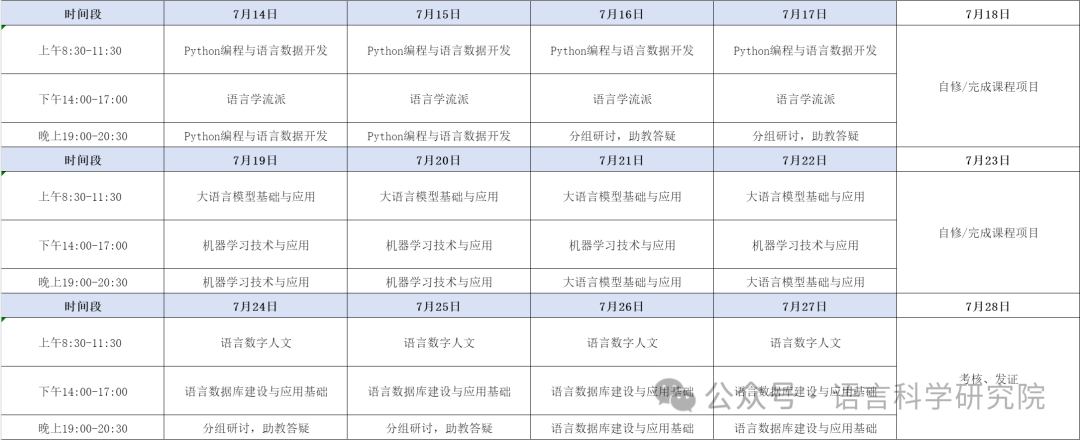
Each summer, the workshop will offer 15 days of cutting-edge micro-program courses and dedicated guidance. This workshop will be held in a hybrid format (in-person + online via Tencent Meeting).
01 Course Schedule
02 Training Fees
In-person:
1. 10,000 RMB/person
2. Group registration (5+ participants): 8,000 RMB/person
Online:
1. 8,000 RMB/person
2. Group registration (5+ participants): 6,000 RMB/person
After registration and payment, please contact Ms. Zhang via WeChat (WeChat ID: 18061256876) to be added to the course group.
For group registration, please contact Ms. Zhang at 18061256876.
Participants may withdraw and request a refund before the start of the training program. After the program begins, withdrawals will be considered as voluntary abandonment, and no refunds will be issued.
03 Registration Method
1. Individual Registration: Scan the QR code to register. Please ensure accurate submission of personal and payment information. (All information must be entered correctly, as it cannot be modified later.)
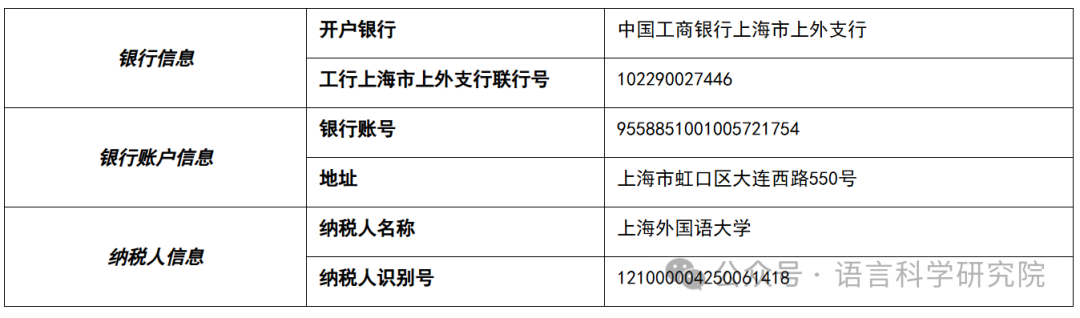
2. Group / Bank Transfer Registration: Before registering, please contact Ms. Zhang via WeChat (18061256876) to confirm group/bank transfer registration details. Payment for group or bank transfer registration should be made via bank transfer, with “Institution + Number of Participants” noted in the transfer remarks. (Individual registrants should use their full name.) Bank account details are as follows:
04 Check-in Location & Registration Period
Check-in Date & Time: July 13, 2025 (14:00–17:00)
Check-in & Venue: SISU Songjiang Campus, Building 5, Room 136
Registration Period: From now until July 27, 2025
05 Important Notes
1. This workshop will be conducted in a hybrid format (in-person + online). The online platform is Tencent Meeting. Participants are requested to download the Tencent Meeting app on their mobile devices or computers and register as users in advance.
2. During the workshop period, Shanghai International Studies University will provide invoicing services and training support.
3. A certificate of completion will be issued by the organizer, bearing the official seal.
06 Contact Information
Institute of Language Sciences, Shanghai International Studies University
Ms. Zhang: 18061256876
07 Instructors
Professor Lei Lei
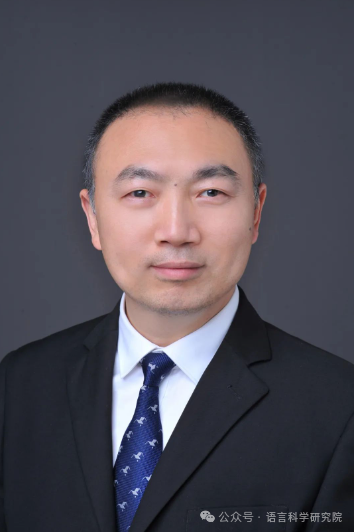
Lei Lei, Ph.D. in Literature, Professor, Doctoral Supervisor, Institute of Language Sciences, Shanghai International Studies University. His research interests include corpus linguistics, digital humanities in language studies, English for Academic Purposes, and quantitative linguistics. He has published multiple monographs with Cambridge University Press, TESOL Press, and Science Press. He has published nearly 40 research articles in SSCI journals such as Applied Linguistics, Language Teaching, International Journal of Corpus Linguistics, and System, as well as over ten book reviews, two of which have been selected as ESI Highly Cited Papers. He has also published over ten articles and book reviews in CSSCI journals such as Modern Foreign Languages, Foreign Language Teaching, and Journal of PLA University of Foreign Languages. He has led and completed multiple research projects, including those funded by the National Social Science Fund of China. He serves on the editorial board of several domestic and international journals, including Journal of English for Academic Purposes (SSCI).
Professor Li Jingjie
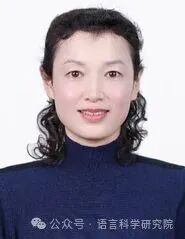
Li Jingjie, Professor, Institute of Language Sciences, Shanghai International Studies University. Her research interests include corpus linguistics, quantitative linguistics, and English for Academic Purposes. She holds a Ph.D. in Foreign Linguistics and Applied Linguistics from Shanghai Jiao Tong University and completed postdoctoral research at the Centre for Information and Language Systems Research, University of Liverpool. She has been granted one national invention patent and has published nearly 20 research articles in SSCI and CSSCI journals such as International Journal of Corpus Linguistics, Foreign Language Teaching and Research, Journal of Foreign Languages, Technology Enhanced Foreign Language Education, and Foreign Languages and Their Teaching. She has led multiple research projects, including those funded by the National Social Science Fund of China and the Shanghai Social Science Fund.
Associate Professor Li Yan
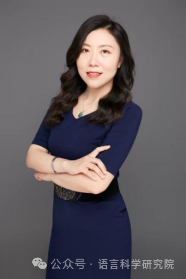
Li Yan, Associate Professor, Master’s Supervisor, Institute of Language Sciences. She currently teaches core courses including Machine Learning Technology and Applications, Knowledge Graphs, Python Programming and Data Analysis, Advanced Mathematics, and Linear Algebra. She has led vertical research projects such as those funded by the National Natural Science Foundation of China, sub-projects of Major Projects of the National Social Science Fund of China, the Shanghai University Outstanding Young Teachers Special Fund, and SISU university-level research projects. She has also led horizontal research projects commissioned by the Shanghai Development and Reform Commission, Shanghai Yuankai Group, and China State Shipbuilding Corporation. She has received international paper awards, national-level outstanding case awards, and honors including Shanghai Industry-Education Integration Outstanding Mentor, Key Discipline Faculty Member, and SISU March 8th Red Banner Awardee.
Associate Professor Ni Qin
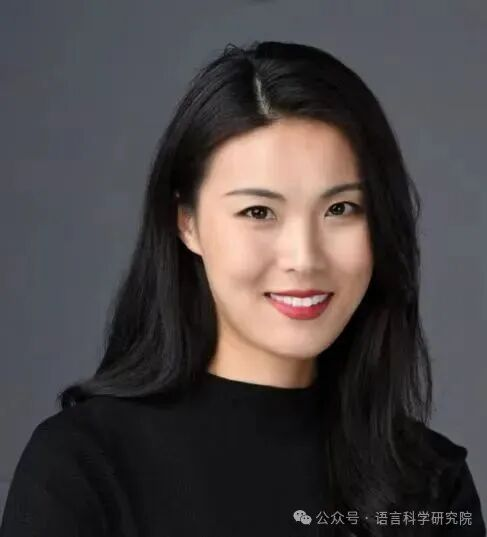
Ni Qin, Associate Professor, Master’s Supervisor, Institute of Language Sciences, Shanghai International Studies University. She holds a Ph.D. in Computer Science and Technology from the Technical University of Madrid, Spain. She is a member of the International Expert Group on AI and Education at UNESCO. Her research interests include AI applications in education, big data analytics in education, and intelligent education governance. As a drafter, she participated in the development and release of official UNESCO documents: Guidance for Generative AI in Education and Research and AI Competency Framework for Teachers.
Assistant Research Fellow Xu Hongzhi
Xu Hongzhi, Ph.D., Assistant Research Fellow, full-time researcher at the Key Laboratory of Language Sciences and Multilingual Intelligent Applications and the Institute of Language Sciences, Shanghai International Studies University; Zhiyuan Young Scholar. His main research interests include computational linguistics, formal semantics, pragmatics theory and computation, and the analysis and computation of cross-linguistic morphology.
Assistant Research Fellow Li Xiaoqian
Li Xiaoqian, Assistant Research Fellow, Institute of Language Sciences, Shanghai International Studies University. She holds a Ph.D. in Foreign Languages and Literatures from Shanghai Jiao Tong University. Her research areas include corpus-based translation studies, diplomatic discourse studies, and image studies. She leads a Youth Project of the National Social Science Fund of China and a General Grant from the China Postdoctoral Science Foundation.